Digital transformation in the cultural and creative sectors is often framed as an internal challenge: a new CRM, a better ticketing system, a smarter dashboard. The implicit assumption is that if each organisation “gets its digital house in order,” the sector as a whole will progress.
EXCENTRIC starts from a different premise: no cultural organisation can meaningfully transform alone.
In experience-based sectors such as live music, festivals, theatre, and museums, value is not produced in isolation. It emerges from dense networks of artists, venues, audiences, funders, cities, platforms, policymakers, and infrastructures. Digital transformation, therefore, is not merely a technical upgrade inside institutions — it is an ecosystem challenge.
Cultural ecosystems are not new. Cultural economists and policy scholars have long described culture as a system of interdependent actors rather than a collection of standalone organisations (Holden, 2015; Throsby, 2001). What is new is the way data flows — or fails to flow — through these systems.
Today, most cultural data is:
-
Fragmented across organisations
-
Locked into proprietary platforms
-
Underused in daily operations
-
Rarely shared beyond institutional boundaries
This fragmentation creates blind spots. Programming decisions are made without sector-wide insight. Audience understanding stops at the organisational edge. Policy is shaped by partial or outdated evidence. Even well-intentioned digital tools often reinforce silos rather than dismantle them.
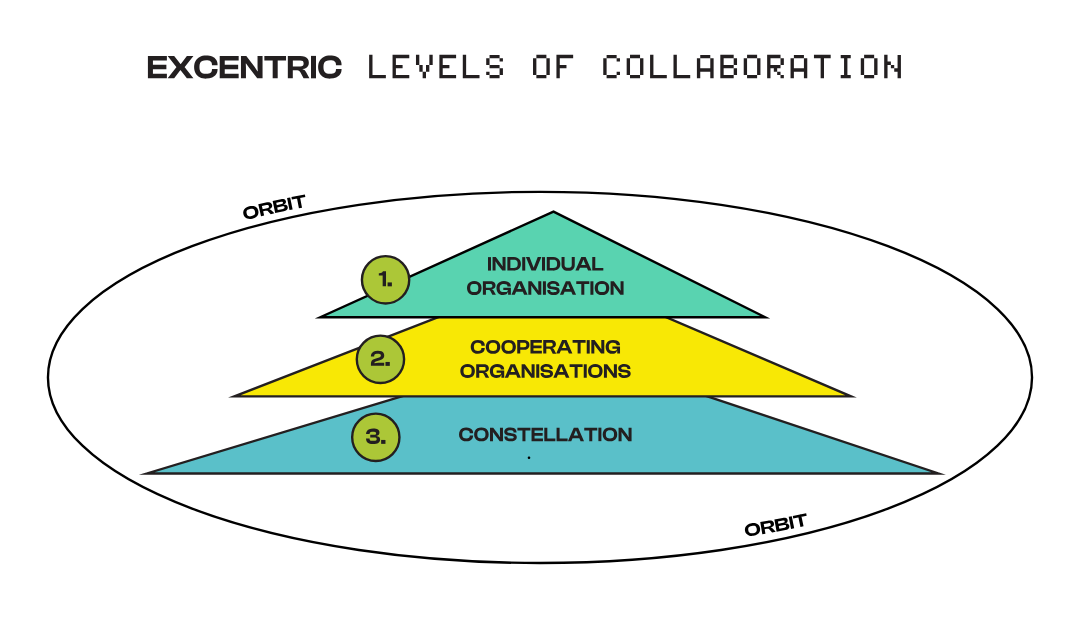
EXCENTRIC responds by reframing digital transition as an ecosystem-level redesign, not an organisational optimisation.
From data ownership to data relationships
In many cultural organisations, data is treated as an asset to be protected: something owned, controlled, and guarded. This logic mirrors market-driven digital models, but it sits uneasily with the collaborative realities of cultural production.
EXCENTRIC introduces the idea of Collaborative Data Practices (CDPs), an approach already tested in sectors such as healthcare, energy, and logistics. The shift is subtle but profound:
-
From who owns the data → to how data is stewarded collectively
-
From isolated datasets → to shared operational insight
-
From competition over information → to coordination around shared challenges
In cultural ecosystems, this means enabling organisations to benefit from shared learning without losing autonomy, identity, or artistic control.
Trust is the real infrastructure
Research on data commons and collaborative governance consistently shows that technical interoperability alone is insufficient (Ostrom, 2010; Benkler, 2016). What matters is the social architecture: norms, incentives, and shared purpose.
By embedding human-centric principles into tool design and governance models, EXCENTRIC treats trust not as a “soft issue” but as a design requirement.
Cross-organisational data collaboration only works when:
-
Governance models are transparent
-
Roles and responsibilities are clearly defined
-
Ethical boundaries are explicitly negotiated
-
Human relationships are prioritised over technical efficiency
One of EXCENTRIC’s strengths is combining pan-European collaboration with deeply local practices. Cultural ecosystems do not scale like tech platforms. What works in a festival network in Finland may not translate directly to a museum context in Italy. EXCENTRIC does not aim to standardise solutions, but to create transferable principles like shared metrics, modular tools and learning networks, not one-size-fits-all platforms
This approach resonates with recent EU cultural policy thinking, which increasingly emphasises capacity-building, peer learning, and contextual adaptation over top-down digital mandates (European Commission, 2022).
Towards sustainable cultural ecosystems
Ultimately, ecosystem thinking is about sustainability – not only environmental or financial, but organisational and social sustainability. By breaking down silos, building shared capacities, and fostering collaborative data practices, EXCENTRIC aims to:
-
Reduce duplication of effort
-
Strengthen resilience in small and medium-sized organisations
-
Enable smarter, fairer decision-making
-
Support innovation beyond the project’s lifetime
Digital transformation, in this view, is not a destination. It is a collective learning process — one that only works when culture is treated as a living ecosystem rather than a collection of isolated institutions.
References
-
Benkler, Y. (2016). Peer Production and Cooperation. Oxford University Press.
-
European Commission (2022). Culture and Creativity for a Sustainable Future.
-
Holden, J. (2015). The Ecology of Culture. Arts and Humanities Research Council.
- Janssen, M., Brous, P., Estevez, E., Estevez, E., Barbosa, L. S., Barbosa, L. S., Janowski, T., & Janowski, T. (2020). Data governance: Organizing data for trustworthy Artificial Intelligence. Government Information Quarterly, 37(3), 101493. https://doi.org/10.1016/J.GIQ.2020.101493
-
Ostrom, E. (2010). Governing the Commons. Cambridge University Press.
-
Throsby, D. (2001). Economics and Culture. Cambridge University Press.
More Insights